Wednesday, November 16, 2011

Amazon’s Kindle Fire Draws Heat From New Nook: Rich Jaroslovs


Nov. 17 (Bloomberg) -- There’s a lot of heel-nipping in the tablet market these days.
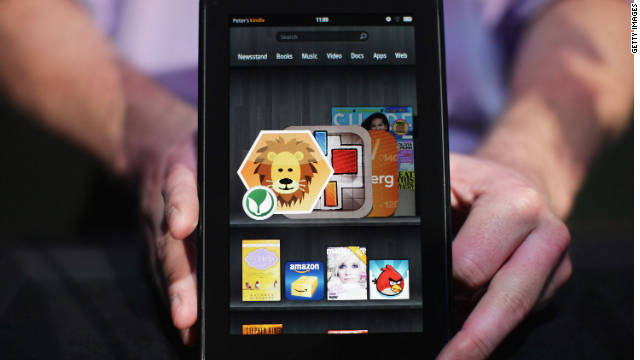
Amazon.com Inc. just released the Kindle Fire, the most serious attempt yet to take on Apple Inc.’s mighty iPad 2. Meanwhile, Barnes & Noble Inc. has shipped the Nook Tablet, which in turn takes aim at Amazon.
I’ve tried both new devices and my conclusion is that there’s no clear winner. They’re both compact, capable color- screen media-consumption devices for budget-minded users who don’t need all the features and functions of a full-blown tablet.
There’s a lot to like about the Fire. I like the way Amazon has integrated its content services -- books, magazines, videos, music. I like how it uses the Cloud, in this case, Amazon’s remote servers, to store content and make it accessible when I want it, reducing the need for a lot of storage. (The Fire only holds 8 gigabytes -- same as the base model iPod touch.)
Most of all, I like the price: $199, less than half the cheapest iPad.
When I booted up the Fire, all my previous Amazon purchases appeared automatically and Amazon made it exceedingly easy for me to add more content. I bought a couple of books, some songs and a movie for a long airplane ride. All downloaded quickly and efficiently. There’s also an Amazon site with some 8,500 Amazon- approved apps, far fewer than Apple has for the iPad, but still respectable.
Prime Content
Users of Amazon’s $79-a-year Prime service get access to a library of thousands of TV shows and older movies, somewhat akin to Netflix Inc.’s streaming service. The Fire comes with a one- month trial subscription.
So I like almost everything about the Kindle Fire -- except, well, the device itself.
The Fire is plain, a chunky black rectangle with a 7-inch backlit color screen. It’s shorter than the Nook Tablet, a bit thicker and heavier. In action, it feels sluggish. There can be a noticeable lag when you’re turning pages in an e-book or using an app.
I also had trouble with the accelerometer, the sensor that changes the view from portrait to landscape when you turn the Fire. I sometimes found myself looking at an upside-down app for several moments until the Fire sorted things out. And my loaner fell short of Amazon’s claimed eight hours of battery life.
Silk Isn’t Smooth
Amazon claims that its Web browser, Silk, has been optimized for speed, but in side-by-side comparisons I couldn’t discern any advantage over the iPad’s Safari browser. A few times the device told me it was connected to a Wi-Fi network while Silk claimed it wasn’t. There’s no 3G data service for the Kindle Fire, nor are there Bluetooth, a physical volume control, or a camera of any kind.
The Fire runs Google Inc.’s Android mobile-phone operating system. So does the $249 Nook Tablet, whose earlier version, the Nook Color, remains on the market with a newly lowered $199 price tag.
The Nook Tablet, like the Fire, operates only over Wi-Fi and has no camera. In other ways, though, it is the reverse of the newest Kindle. Where the Fire is physically plain, the Nook is sleek and more visually appealing. The $50 price differential buys you not only twice the memory and twice the storage of the Fire, but also longer battery life and a slot for an SD expansion card.
Smooth Scrolling
Barnes & Noble’s one-year head start in developing software really shows: scrolling is smoother, the screen reorients itself faster and the device just generally feels zippier.
Where B&N falls short is exactly where Amazon shines -- in the variety of content available and how well it’s integrated into the overall user experience.
Books aren’t the problem. The Nook’s selection is impressive and it has some nice flourishes. On-the-go parents, for instance, will appreciate not only the kid-friendliness of the Nook Tablet but also a feature that lets them record a child’s favorite story in their own voice.
For many other uses, though, the Nook Tablet relies on third-party apps in place of the one-stop shopping approach of Amazon and Apple. For movies and TV shows, there’s Netflix and Hulu Plus; for music, Pandora; and so on. Each requires a separate membership with its own login and, in the case of Netflix and Hulu Plus, credit card information.
Like Amazon, Barnes & Noble has its own app store that pales next to the iPad’s in terms of both numbers and quality.
Ultimately, the choice between these two devices comes down to Amazon’s lower price and ecosystem versus Barnes & Noble’s polish and network of brick-and-mortar stores to provide in- person support. In either case, paying half what an iPad costs will require you to decide which half of the iPad experience you’re willing to do without.
(Rich Jaroslovsky is a Bloomberg News columnist. The opinions expressed are his own.)
--Editors: Jeremy Gerard, Zinta Lundborg.

Thursday, November 3, 2011

Vook White Paper Tackles Common E-Book Formatting Errors

Re-post from: http://www.publishersweekly.com/pw/by-topic/digital/content-and-e-books/article/49360-vook-white-paper-tackles-common-e-book-formatting-errors.html?utm_source=Publishers+Weekly%27s+PW+Daily&utm_campaign=886920b518-UA-15906914-1&utm_medium=email

Vook has posted a white paper called "Ebook Errors: How to Avoid 5 Common Problems," highlighting common formatting errors that frequently pop up for publishers when transferring their titles to digital. The white paper features Elizabeth Castro, author of EPUB: Straight to the Point, Pablo Defendini from Open Road, and Kassia Krozser from Booksquare.
The focus of the report was a solution list for five common problems in e-book formatting. The problems were: Headers with Hyphens; Chapter titles, Headers, and Sub-Headers Separated on Different eBook Pages; Unsightly Indentation, and Random Blank Pages in the eBook; Strange Characters Inserted into eBooks; eBook Aesthetics.
For example, the report states that the problem of sloppy indentation and blank pages are often caused when converting EPUBs from Microsoft Word. Many users of Word use "Tab" to indent paragraphs and "Enter" to insert line breaks, rather than using Word's formatting styles. The solution: if hand-coding an e-book, one should apply styles to the document (in Word or InDesign) before converting the file to EPUB.
The report also outlined the various contributing factors that lead to errors, which Defendini said would persist as long as e-books "remain second class citizens in the production workflow," meaning that print worklfow still dictates e-book workflow. Krozser expects to see changes in workflows on an imprint-by-imprint basis, "particularly those where e-book sales are approaching 50% of revenues." On a more general level, both Defendini and Krozser agreed that creating a single XML file at the outset of production would address many of the e-book errors currently plaguing publishers.
Vook's white paper can be read here: http://thanks.vook.com/errors/.

Wednesday, October 26, 2011

Smaller, cheaper tablets could become a big deal

Saturday, October 15, 2011

5 E-Book Trends That Will Change the Future of Publishing


Philip Ruppel is president of McGraw-Hill Professional, a leading global publisher of print and electronic content and services for the business, scientific, technical, and medical communities.
Repost from: http://mashable.com/2010/12/27/e-book-publishing-trends/

Without a doubt, the e-book is practically the biggest thing that’s hit the publishing industry since the invention of movable type. Publishers and e-book resellers are reporting astronomical growth.

At McGraw-Hill, we have been an active player in e-book technology dating back to devices like the RocketBook (one of the first e-book readers) that was launched more than 10 years ago. And today, e-books and e-book distribution is central to our publishing and growth strategy.

From the front lines of the e-book revolution, here are five trends I’m watching.


1. Enhanced E-Books Are Coming and Will Only Get Better


Consumers have already shown that they love e-books for their convenience and accessibility, but ultimately most e-books today are the same as print, just in digital form. The e-book of the not-too-distant future will be much more than text. Interactivity has arrived and will change the nature of the e-book.

Imagine video that shows how to fix a leaky faucet or solve complex math problems in statistics; audio that pronounces foreign language words as you read them, and assessment that lets you check what you remember and comprehend what you just read. These interactive features and more are being developed now and will be on the market in a matter of weeks, not months.
Publishers are already conjuring up designs for the enhanced e-book of the future. Imagine still: If you miss five questions on your geometry test, will your book adapt and change to help you learn the questions and concepts you missed? Will your new novel provide a platform for live exchange with reading groups where you can discuss the book with the author? Today’s enhanced e-books that feature talking heads or out-takes from movies are yesterday’s ideas. Consumers will expect a much greater experience.


2. The Device War Is Nearly Over


Devices are proliferating to the point of confusion. Does a consumer buy a Nook, Kindle, Sony e-reader, an iLex or any one of 20 other dedicated e-readers? Or do they buy an iPad, Galaxy Tab, or other Android tablet? Or do they buy an e-reader at all? Have you ever noticed on a crowded train or bus how many people are reading their phone? And for a growing number of readers, the mobile phone is fine for reading just about anything. But as far as devices go, consumer confusion is likely to drive quick consolidation around a few winners in the market — no one wants to own the next “Betamax for books.”

Because most developers are developing e-reader software that will work on multiple other devices (Kindle also works on the iPad, iPhone, and computers, for example), consumers will care less about the device and more about the user experience of the e-reader software, portability of titles from one device to another, and access to a full catalog of titles.


3. The $9.99 E-Book Won’t Last Forever


Amazon popularized the $9.99 price point for best-seller trade titles, driving the widespread consumer adoption of the Kindle and consumption of e-books. This has caused confusion among many consumers who simply think every e-book should be $9.99 or less. But the majority of titles offered on Amazon are priced above $9.99, especially those with unique interactive features. For professional and technical publishers like McGraw-Hill, our e-books cannot stand the low, mass market pricing some consumers think should be applied to every e-book. Our costs are invested in extensive product and editorial development of sophisticated and technical content; the cost of paper, printing, and binding are a fraction of the real expense. And for some very specific and technical subject areas, our markets are much smaller. We simply couldn’t afford to publish the work if it must be priced at the everyday low, low price of $9.99.


The real opportunity for publishers will be to develop e-books that offer the kind of interactive features mentioned above. Our customers will demand interactive books that provide a much better, more informed and enriching experience. For them, the experience (not the cost) is often the primary driver.


4. The Contextual Upsell Will be a Business Model to Watch


E-books allow publishers to interact with their customers in new ways. Imagine customers who are trying to learn statistics and get stuck on a particular formula. They ask friends but no one can explain it well. They’re stuck.

They click a help button, which points them to the publisher site where they can download relevant tutorials about specific formulas for $2.99. They choose the one they need and get a new learning tool, which helps them progress in their class. Multiply this by hundreds of thousands of students who share similar learning gaps who will purchase through the book (“in-book app purchase”) and it becomes an interesting new marketing opportunity.


5. Publishers Will Be More Important Than Ever


Despite the hype around self-publishing via the web, publishing houses will play an even greater role in an e-book world. Commodity content is everywhere (and largely free), so high-quality vetted, edited content — which takes a staff of experts — will be worth a premium.

At McGraw-Hill, the average technical and reference book engages teams of editors, copy editors, proofreaders and designers to produce a single book. In the digital world, the role of publishers will be larger as new technologies provide for an even greater user and learning experience. Furthermore, with the skyrocketing amount of content being served on the web, customers will seek and pay expert content providers that aggregate and contextualize information for them efficiently and provide highly accurate and specific search options. Publishers with expertise and resources in these and emerging areas will be the ones that write the new rules of e-book publishing.

Friday, October 14, 2011

Libraries Fight Back: Ebook Checkouts Up 200%

Friday, September 30, 2011

Amazon Unveils Tablet That Undercuts iPad’s Price


Jeff Bezos, the chief executive of Amazon, introduced the Kindle Fire on Wednesday.
 re-post from http://www.nytimes.com/2011/09/29/technology/amazon-unveils-tablet-that-undercuts-ipads-price.html?_r=1

Seeking to stake a claim in the tablet computer market alongside Apple and Samsung, Amazon.com on Wednesday revealed plans to begin selling a color touchscreen tablet.

Named the Kindle Fire, the device has a 7-inch touchscreen, weighs 14.6 ounces and is outfitted with a dual-core processor. But the most important feature may be the price. At $199 the Fire is less than half the price of the Apple iPad, which starts at $499. It is the first tablet from a major company to seriously undercut the iPad in price.

Jeffrey P. Bezos, Amazon’s founder and chief executive, who showed off the Fire on stage at a news conference in Manhattan, said it was meant to build on the popularity of the company’s e-readers and appeal to a broader audience that also wants to browse the Web and stream music, movies and video. The device has access to Amazon’s library of 18 million e-books, songs and movies and television shows, and can run Android applications that have been approved by Amazon.

There is also a newsstand for users who want to subscribe to magazines, with titles like Cosmopolitan, Vanity Fair, Wired and Glamour.

“We’re building premium products at non-premium prices,” said Mr. Bezos. “We are determined to do that.”
Mr. Bezos also introduced a speedy custom-built mobile browser, called Amazon Silk, which he said was “cloud-accelerated,” combining Amazon’s computing cloud with the Kindle Fire device. “It’s truly a technical achievement,” he said.

Amazon plans to begin taking preorders for the Fire on its Web site immediately, and they will start shipping Nov. 15. Mr. Bezos said the company was “making many millions of these.”

The Kindle Fire includes a free cloud-based storage system, meaning that no syncing with cables is necessary. Mr. Bezos seemed to take a swipe at Apple, saying, “That model that you are responsible for backing up your own content is a broken model.”

Like the iPad’s screen, the screen on the Fire has so-called in-plane switching technology, meaning that unlike some LCD screens it can be viewed from a variety of angles, not just straight on.

Mr. Bezos also introduced several new e-readers, including the Kindle Touch, a lightweight version of its current Kindle models, with the addition of infrared touch features to the black-and-white display. The Touch, which costs $99, has no buttons, and users navigate by tapping the sides of the screen. The device is available for preorder beginning Wednesday and will start shipping Nov. 21. Mr. Bezos showed off a version of the Kindle Touch with 3G wireless connectivity, for $149.

In addition, Mr. Bezos showed off a new, non-touchscreen Kindle that he said was 18 percent lighter than the Kindle 3, includes a faster processor and will sell for $79. It will begin shipping immediately, he said.
“We have many customers who tell us they don’t want touch,“ Mr. Bezos said. “We’re going to sell many millions of these.”

The Kindle Fire has its work cut out for it. Apple has secured a strong lead in tablets, selling more than 29 million iPads in the product’s first 15 months on the market. Its competitors have been less successful. For example, Research in Motion, maker of the BlackBerry line of smartphones, said it only shipped 200,000 of its own rival to the iPad, the PlayBook, in three months.

Amazon will also be competing with the Nook, Barnes & Noble’s popular color e-reader. Many expect the Nook to get an upgrade later this year.

However, Amazon has an ace up its sleeve that other tablet makers do not, in that the Kindle Fire will offer Amazon’s full spread of digital content, said Michael Gartenberg, an analyst with Gartner who follows the consumer electronics industry.

“Amazon has already nailed the hardest part of the equation: the content,” he said.

Early sales estimates for the Kindle Fire reach as high as five million.

“The tablet market right now is easily defined as Apple and everyone else,” said Mr. Gartenberg. “There is certainly room for another player, and a well-executed device from Amazon could do well.”

Saturday, September 17, 2011

E-books push deeper into interactive territory


The big buzz around e-books are devices, like Amazon's upcoming tablet, and apps such as Booktrack that take interacting with stories to a new level.

September 18, 2011

If there's already a tablet in your house — an iPad or an Android-driven one — then this fall, e-books will be all about interactivity. If you don't have a tablet yet, keep your eye on Amazon.

Industry watchers have been predicting that Amazon will introduce a tablet later this year — if so, it stands to be a big hit. In August, the technology and market analysis firmForrester Research said that Amazon could sell between 3 million and 5 million tablets in the last quarter of this year, if the company prices the (not-yet-announced) device at $300 or less.

Amazon proved it could transform the publishing landscape by introducing its Kindle e-reader in November 2007. Before that, e-books were an oddity, and e-readers strange, unloved creatures. After Amazon put the Kindle in front of book buyers, everything changed; readers embraced the device. Last summer, the online bookseller saw e-book sales overtake its print book sales. During the first half of this year, Random House, the world's biggest publisher, saw more than 20% of its U.S. revenue come from e-books.

Now there are many e-readers on which to consume those e-books: Barnes & Noble's Nook, the Kobo, the long-standingSony e-Reader and a multitude of others. Most compete with Amazon's Kindle; a tablet from Amazon would be designed to compete with Apple's iPad.

The iPad can function as an e-reader — it has the native iBooks application — but its real appeal, book-wise, has been in apps. Other tablets, many of which run on the Android operating system, can run apps too, but Apple got a head start. Since the iPad's debut in April 2010, it's been a Wild West of app development, with companies small and large creating apps that allow books to move and more.

One of those lets you create an animated children's e-book starring your own son or daughter. JibJab Media, the onlineanimation house with its roots in political satire, launched JibJab Jr. on Sept. 1 with a free e-book, "The Biggest Pizza Ever." After two simple steps — selecting a gender and adding your child's photo — the story commences with your child's face included in the page-by-page animation. Future books coming out this fall are about the alphabet and the ocean, and these cost $3.99 for an individual version or $7.99 to customize for more than one child.

Some apps debuting this fall are far out. Take Booktrack, whose announcement party in New York featured models in neon-pink wigs demonstrating enhanced e-books to Salman Rushdie, filmmaker Paul Haggis and James Frey. Enhanced with what? Music and a soundtrack. The app tracks along at your reading speed, so when a door closes in a Sherlock Holmes story, there's a slam, and when things get scary in "Hansel and Gretel," the music swells. The chief investor in Booktrack is Peter Thiel, chief executive of Paypal; and Sony Music is a partner. Upcoming Booktracks, which cost a few dollars more than their non-enhanced counterparts, include short stories by Rushdie and Jay McInerney.

Publishers are still trying to figure out how to best make e-books people want. You might buy one that comes with a video interview from the author, or a code to scan with your smartphone to access online extras, or find that Lee Child and Stephen King have short stories available only as e-books. Random House has partnered with Politico to publish real-time e-book coverage of the 2012 presidential election, with the first releases planned for this fall. Also look for an e-book from David Sedaris and the e-book version of previously unreleased interviews withJacqueline Kennedy Onassis.

Despite all the buzz about devices, the Internet hasn't gone away: It remains a destination. One quiet project, Small Demons, won't be unveiled until October but it promises to mix books and online in new, innovative ways. And online is the focus of the high-profile Pottermore, J.K. Rowling's official interactive website for all things Harry Potter. It will open up for public access in October; reviews from users who've had early access have been strong. So far, the Harry Potter series has not been released as e-books but with any luck, Rowling will have that set up before the holidays.